Weber brings Space Camp experience back to Delta State classrooms
Cleveland, MS (07/30/2026) — Contact: Nathan Duff FOR IMMEDIATE RELEASE
Phone: (662) 846-4678
Email: nduff@deltastate.edu
Weber brings Space Camp experience back to Delta State classrooms
CLEVELAND, Miss. - Dr. Maria Weber, Associate Professor of Physics and Director of Delta State University's Wiley Planetarium, recently completed Space Academy for Educators at the U.S. Space & Rocket Center in Huntsville, Alabama, gaining new activities, resources and perspectives she plans to incorporate into her teaching and outreach programs.
The six-day professional development program allows educators to experience astronaut training simulations, simulated space missions and hands-on engineering challenges while exploring ways to bring the excitement of space exploration into their classrooms. Participants also receive access to NASA-inspired lesson plans and resources that can be adapted for different grade levels and learning environments.
Weber first learned about the program while attending a planetarium conference at the U.S. Space & Rocket Center. As an astrophysicist whose research focuses primarily on stars and solar physics, she saw the program as an opportunity to expand her knowledge of human spaceflight while gathering ideas for her Delta State courses, planetarium programs and youth outreach.
"Their primary goal for us was to impart information that we can take back and incorporate into our classes," Weber said. "They gave us resources, so I can do a lot of the activities we did with my students. Then they had us experience all the things the kids do."
Participants trained for and completed two simulated space missions, practiced leadership and communication skills and took part in engineering activities designed to be replicated in educational settings.
One challenge required teams to design a lander carrying a rover and an egg representing an astronaut. The lander had to protect its contents during a two-story drop before the rover was deployed and traveled a required distance without breaking the egg. In another exercise, participants engineered heat shields and tested how long they could protect an egg from an intense heat source.
Weber said the lander activity could be adapted for her introductory astronomy course, while the heat-shield challenge could be modified for physics students using classroom-appropriate equipment. She is also considering developing an escape-room activity focused on the history of spaceflight for older students or planetarium visitors.
The experience also gave Weber a broader understanding of NASA's human exploration programs and the history of missions to the moon, the International Space Station and other destinations. That knowledge will help her answer questions from planetarium audiences whose interest in astronomy often begins with astronauts and space exploration.
Another lesson Weber plans to bring into her teaching is the importance of collaboration. Space Camp is built around teamwork, leadership and decision-making, with participants assuming different roles that must work together for a mission to succeed.
"You don't really get a good feeling for it until you're at Space Camp, but so much of being an astronaut is about working on a team and communicating with each other," Weber said. "There are a lot of different specializations that have to work together, and everybody has to pull their own weight. Otherwise, the whole system crumbles."
Weber also plans to apply what she learned to Delta State's annual ASTRO Camp, a weeklong summer program that introduces children to astronomy and other STEM subjects through planetarium presentations, experiments and hands-on projects. This summer's camp welcomed approximately 20 students from multiple age groups.
With renovations underway at the Wiley Planetarium during this year's camp, Weber said she anticipates an expanded experience when the program returns next summer. Ideas gathered in Huntsville will help Delta State make future ASTRO Camps more immersive while strengthening planetarium workshops and professional development opportunities for area teachers.
Space Camp has operated at the U.S. Space & Rocket Center since 1982. Its educator program is open to teachers from all disciplines and focuses on classroom applications of science, technology, engineering and mathematics while also incorporating history, art and literacy. More information is available through the U.S. Space & Rocket Center.
For more information about STEM programs at Delta State University or upcoming events at the Wiley Planetarium, contact Weber at mweber@deltastate.edu or 662-846-4478.
Cutline: DSU's Dr. Maria Weber (front row, right) joined educators from around the country for Space Academy for Educators at the U.S. Space & Rocket Center in Huntsville, Alabama.
###
About Delta State University: Delta State University is a four-year public institution whose nearly 2,800 students come from most U.S. states and more than 45 countries. Acknowledging its beginning as a teacher's college, the University sustains excellence in teacher education while continuing to expand offerings in traditional as well as unique fields of study. Programs such as those available through the Delta Music Institute, the Commercial Aviation Department, and the Center for Interdisciplinary Geospatial Information highlight the University's commitment to meeting the evolving needs of the students it serves with world-leading, industry-acclaimed programs. Situated in the heart of the Mississippi Delta, Delta State offers top-notch academic programs in business, arts, sciences, nursing, education, and more. DSU Athletics has won 15 national championships, 70 conference championships, and 37 regional titles.
Media Attachments

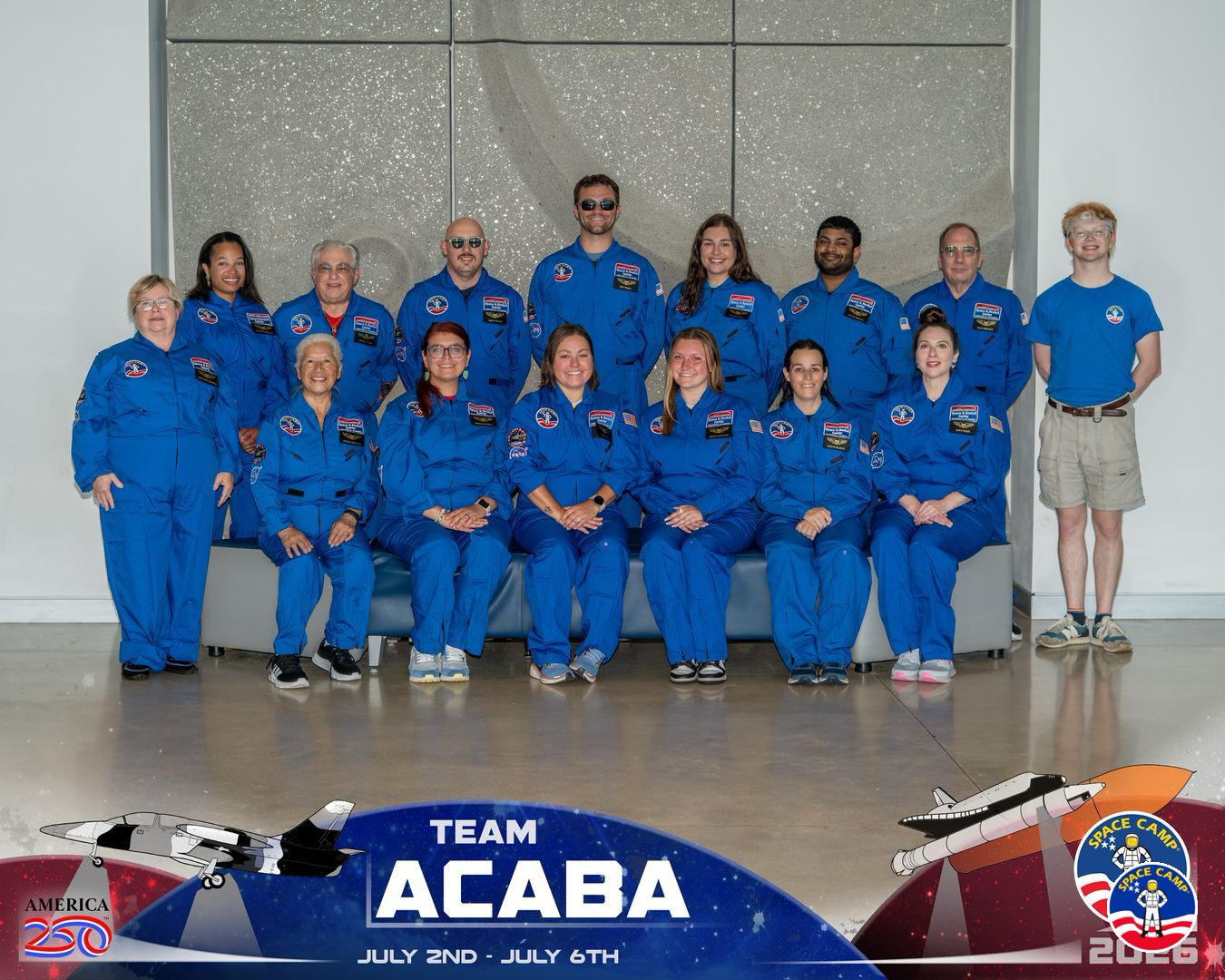
DSU’s Dr. Maria Weber (front row, right) joined educators from around the country for Space Academy for Educators at the U.S. Space & Rocket Center in Huntsville, Alabama.